
A life that
shaped a town.
Jadab Chandra Das — educator, writer, publisher and community builder whose vision helped shape modern Howly.
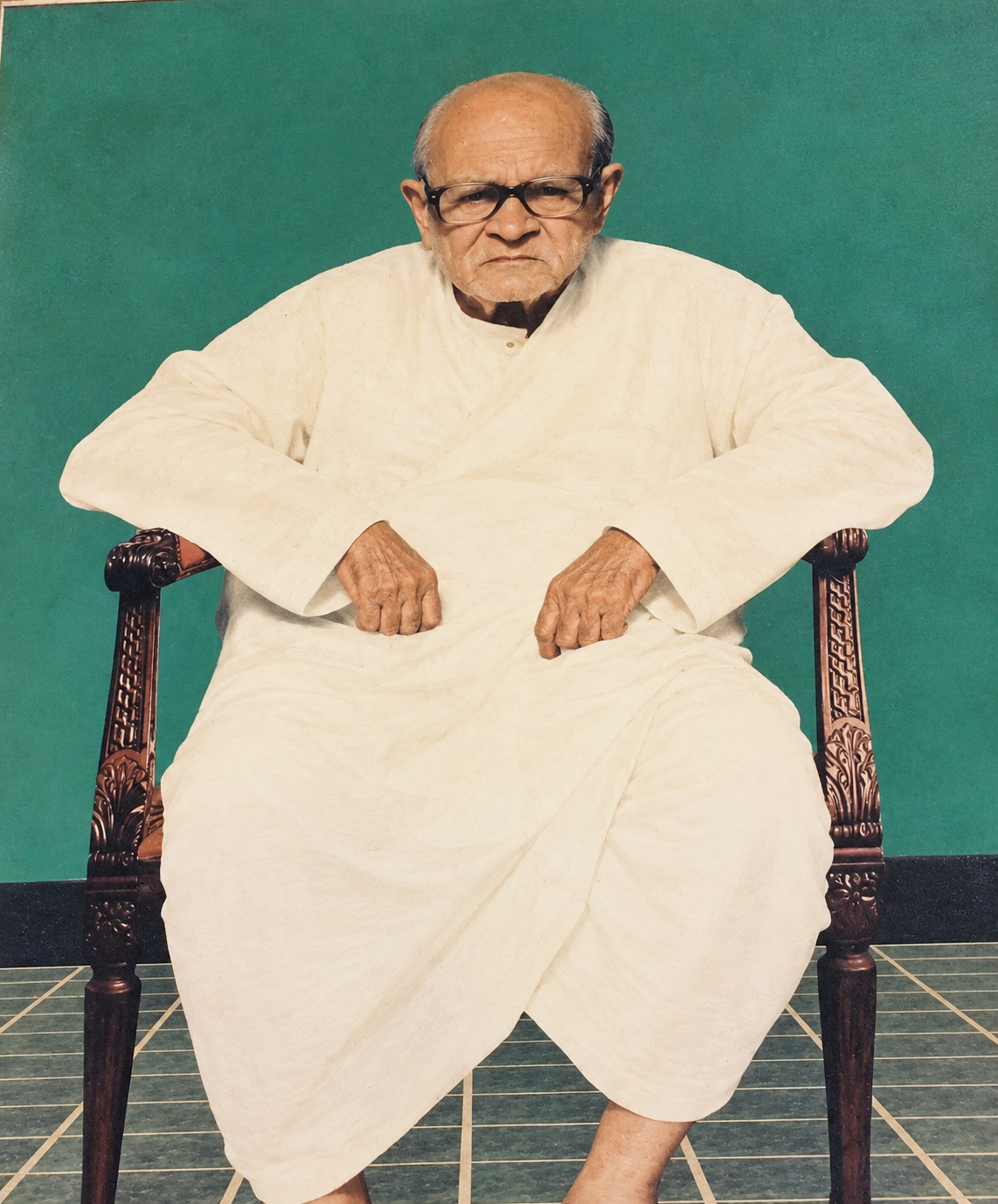
His legacy was built in classrooms, libraries, fields and the heart of the community.
Jadab Chandra Das devoted his life to widening access to education, preserving Assamese knowledge, encouraging literature and helping establish institutions that would serve generations.
From hardship
to purpose.
Jadab Chandra Das was born on 9 August 1913 in Moiramara village in Howly. His father was Ramakanta Das and his mother was Bhogeshwari. His childhood was marked by hardship, and he lost his mother when he was about nine years old.
After this loss, his father, Ramakanta Das, decided to move to the area that is now Howly market, hoping to build a better life. In those days, the surrounding landscape was remembered for its wildlife, including tigers, wild boar and deer. Over time, the settlement grew into the town of Howly known today.
There was no high school in Howly, so Jadab travelled to Barpeta for his education. Roads and transport were limited; students often walked long distances, sometimes carrying a machete for protection against wild animals.
He studied alongside Jiten Das, who later became Vice-Chancellor of Dibrugarh University. Because Jadab's family was poor, he could not afford the private tuition his classmate received. Instead, he would quietly sit behind the school after classes and listen, determined to learn whatever he could. Despite these obstacles, he consistently ranked first in his class.
Learning as an act of courage.
Although he deeply wanted to continue his higher education, the Cunningham Circular of 1930 led him to boycott English education as part of the freedom movement. Inspired by the leadership of Ambikagiri Raichoudhury, he joined the struggle against British rule.
His commitment to learning remained strong. He later enrolled at Jorhat Normal School, where he graduated at the top of his class and began his professional life as a teacher.
At Jorhat Normal School, he met Harinarayan Dutta Barua, whom he regarded as a lifelong mentor. His spiritual guide was Srimat Swami Krishnananda Brahmachari, from whom he received religious initiation. During difficult moments, he would seek his guru's counsel and encouragement.
The influences of Ambikagiri Raichoudhury, Harinarayan Dutta Barua and Swami Krishnananda Brahmachari remained evident throughout his life, shaping his public service, intellectual curiosity and spiritual outlook.
Institutions that outlast a lifetime.
Jadab Chandra Das played an important role in the growth of Howly, helping to establish and support institutions that strengthened its civic, educational and cultural life. His work was associated with educational institutions, a hospital, a police station, the Howly branch of the Asam Sahitya Sabha, Chandi Baruah Memorial Bhawan and the Howly Raas Mahotsav.
One of his most ambitious ideas was to establish a college for the area. He began with little money, bringing together education-minded residents and social workers who shared his belief that higher education should be accessible to local young people.
The first public meeting to discuss the college was held at Howly Chandi Baruah Bhawan, under the chairmanship of Mauzadar Abdul Kader Choudhury. Residents from different religions and linguistic communities attended and supported the proposal.
Recognising that Howly alone could not shoulder the financial responsibility, organisers sought the cooperation of Barpeta Road residents. A subsequent meeting took place at Gopinath Bordoloi Memorial High School in Barpeta Road, chaired by community leader Mohanlal Choudhury. People from different backgrounds again expressed support, and an ad hoc committee was formed.
At a later public meeting at Bordoloi High School, chaired by Kamal Chandra Mazumdar, then Sub-Divisional Officer of Barpeta, some attendees argued that the college should be located in Barpeta Road. After discussion and intervention by respected community members, the meeting agreed on a location between Howly and Barpeta Road. The proposed institution was named “Barpeta Road–Howly College,” known today as B.H. College.
Preserving knowledge, one page at a time.
Jadab Chandra Das undertook the demanding work of recording and publishing religious teachings. He visited Swami Krishnananda Brahmachari's ashram at Manikpur several times and painstakingly wrote down the guru's explanations of the Srimad Bhagavata. Members of the ashram helped him with this work.
He also prepared and published a book known as Namghosar Bhabamrit, recording the Swami's explanations by listening and writing them down. The preparation of these works took years and required substantial physical and financial sacrifice. At one point, a press in Calcutta sent word that the first part of a book had been printed and could not be stored for long without considerable expense. His devotion to his guru and to preserving the teachings kept him committed despite these difficulties.
His publishing work enriched Assamese literary and educational life. He encouraged other writers, brought books into print and helped make useful knowledge available to readers across Assam.
Faith
Recorded and shared religious teachings with patience and devotion.
Literature
Published works that supported Assamese reading and learning.
Public knowledge
Helped preserve local history and knowledge for future generations.
A publisher with a public mission.
His father, Ramakanta Das, established Panchratna Farm in 1926. Jadab Chandra Das later expanded it into a fuller publishing enterprise, producing religious, social and educational books and encouraging others to write.
He published the Prachin Kamrup Panjika, described in the source account as the first Assamese almanac. With help from scholars in different parts of Assam, including the Sarthebari region, he continued publishing almanacs over a number of years. The Assamese calendar he issued also became a familiar presence in many homes.
Among the titles associated with his work are the following. Original titles are retained in transliteration where available.
His schoolbooks—including general knowledge, health, geography, grammar and early-reading texts—were reportedly approved for educational use and found readers across Assam. Bausi Barnagarar Itibritta, written in his later years, preserved valuable historical information that might otherwise have disappeared. Researchers and university scholars consulted the book and, according to the account, sometimes visited him for further details.
He also took an interest in the revival and preservation of declining satras, the Vaishnavite monastic and cultural institutions of Assam.
Practical wisdom, generous hands.
Beyond teaching, writing and institution-building, Jadab Chandra Das was an experimental farmer. He tested different cultivation methods and surprised people by growing potatoes using natural methods without chemical fertilisers. The potatoes reportedly weighed between half a kilogram and one kilogram each, and his work earned recognition from the Assam agriculture department.
Even with his many responsibilities, he grew a variety of vegetables on a plot of land and distributed them among local people. Having experienced hardship himself, he remained attentive to the needs of poor and vulnerable families. He helped students by accommodating them in his own home and supporting their studies.
Former minister Ismail Hussain publicly acknowledged the encouragement he had received from Das, crediting his inspiration as one influence on his own political progress. His support for people was practical, personal and rooted in the belief that opportunity should be shared.
A life of conviction and compassion.
Jadab Chandra Das was remembered as a person of sound health, a strong mind, deep religious faith and a commitment to useful work. His life brought together spiritual devotion and civic responsibility, making him a role model to those who knew him.
The account recalls that, when a message was conveyed to noted literary figure Birendra Kumar Bhattacharya at Das's request, Bhattacharya reflected on the contrast at the heart of Das's life: although he had joined the freedom movement and boycotted English education under colonial rule, he later worked tirelessly to open pathways to higher education for thousands of children in independent India.
Through persuasive speech, clear judgement and an ability to bring people together, Das helped turn ideas into collective action. His contribution to Howly was not limited to any one field: it extended across education, literature, publishing, religious culture, agriculture and social welfare.
Editorial note: This page is an English-language adaptation of the Assamese biographical account supplied for publication. Some book titles are transliterated, and historical descriptions are presented as reported in that account. The exact date of his death was not provided in the source text.
His story is part of Howly’s story.
To understand a town, we must remember the people who invested their time, knowledge and care in its future. Jadab Chandra Das remains an important figure in the story of Howly and the wider Barpeta region.